_"The Pride of Africa"
A rail journey of adventure, luxury -- and education
© Copyright William Ecenbarger
Chicago Tribune & The Philadelphia Inquirer
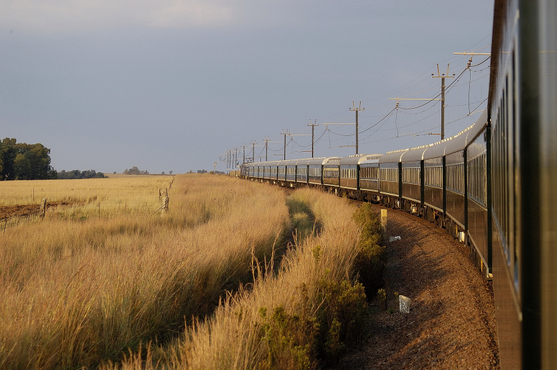
ABOARD THE PRIDE OF AFRICA--From my mahogany-paneled suite, the vast, craggy infinitude of the Great Karoo-- that semi-desert that stretches across the center of South Africa -- runs to the horizon in all directions. I scan the primordial landscape and can almost imagine roaming dinosaurs and cave walls lined with stick figures.
Three thousand years of history have accumulated here and entwined themselves in myth. All thoughts leave my head and the land fills it, and I think I can almost make out the faint, imperceptible arc of the Earth itself. Then I am jolted alert by the awareness that the clackety-clacks are getting farther apart. The train is slowing. There are no outskirts to prepare you for the town. Suddenly there are dusty streets lined with perfectly preserved Victorian houses. I need to immediately set my watch back about 100 years. The Pride of Africa hisses to a stop. The station sign says "MATJIESFONTEIN." There is a hotel with turrets and wrought-iron balconies, a post office, a jail and a courthouse. It is the kind of place that might have intrigued Rudyard Kipling, Randolph Churchill and Cecil Rhodes. And did.
At the 110-year-old Matjiesfontein courthouse, big-bladed ceiling fans battle the heat to a draw. Motes of dust dance in the sunlight. At the podium, a man who reminds me of Alistair Cooke is lecturing to an audience of about 50 men and women seated on folding chairs. Diamond points of intelligence dart from his eyes. "What happened around 1990 is that black consciousness became a wildfire.They said, 'No more!'" His voice tugs at our sleeves. "Within a few years, the white political elite lost its belief in the justice of its rule...."
A half-hour later, the lecture is over and we file out of the courthouse and reboard the train, to resume our journey northward. With a loud and cheery blast of its whistle, The Pride of Africa shudders and pulls out of the station. I dress for dinner (jacket and tie compulsory) and head for the dining car.
A six-day rail journey across South Africa's spectacular heartland -- from Cape Town, through rolling vineyards, the Hex River Valley, the Great Karoo, teeming Johannesburg, the jacaranda-lined streets of Pretoria and diamond-studded Kimberley -- was the centerpiece of a two-week Smithsonian Journeys tour of southern Africa.
The train was lush and lavish, carefully restored to Edwardian elegance -- and decadence -- by Rovos Rail. Nevertheless, there was little of the isolation and detachment of most luxury travel. Smithsonian Journeys is not your typical tour operator, and it pulled no punches about South Africa. There was a visit to a prison, an in-depth look at the horrors of apartheid and ongoing discussions on such subjects as raging unemployment and the devastating AIDS epidemic.
Every evening there were pre-dinner lectures by the two Smithsonian study leaders -- David Welsh and Michael Savage, both retired University of Cape Town professors who were friends and student radicals as undergraduates. As professors, they continued to oppose apartheid in lectures and in writing and were acquainted with most major anti-apartheid figures, including Nelson Mandela, Alan Paton, Stephen Biko and Desmond Tutu.
The dining car, returned to its original 1911 splendor, had fluted teak pillars and arches, mahogany tables covered with damask cloths, fresh flowers and special Rovos china. Each table was ablaze with crystal and silver. We started with a mango butternut squash soup -- the first of six courses -- but portions were small enough to allow you to finish all of them. There were seven choices of entrees, including one vegetarian. Always there was a selection of great South African wines.
Over the muffled tinkle of cutlery, there were earnest, lively conversations.The diners' mouths were full of food and laughter and praise for the chefs.Welsh, the lecturer earlier in the evening at Matjiesfontein, raised a ruby-red glass of pinotage, appraised it with appreciation, and said, "I have done many,many tour groups over the years, and I can tell you without exception that Smithsonian Journeys attracts a different sort of person. They pepper you with questions from morning to night. They are intensely curious....I'll wager that most of the people here have done other Smithsonian trips."
Across the aisle, at the next table, Yvonne Llewellyn, a retired financial analyst from Pasadena, Calif., leans over and confesses to eavesdropping. "This is my 12th Smithsonian trip," she confides. "I started in 1990 with a trip to Patagonia." Since then she has rounded Cape Horn, climbed the Pyramids, cruised the Yangtze and the Danube, ridden an ice breaker through the Bering Sea,explored the Galapagos Islands, marveled at the Taj Mahal, frolicked with penguins in Antarctica and stayed up for the white nights of Iceland in June.
"There's nothing like the combination of adventure, luxury and education," she adds. "My only problem is to decide what I'm going to do next year."
Before beginning our rail trip, we spent three days in Cape Town, one of the world's most beautiful cities. Nevertheless, the highlight was a ferry ride to bleak Robben Island, where Nelson Mandela and leaders of the anti-apartheid movement were imprisoned during the struggle for democracy. There was a hushed reverence as we stood outside Mandela's tiny cell, and I recalled a passage from his autobiography, "Long Walk to Freedom," about his first day in prison: "When I lay down, I could feel the wall with my feet and my head grazed the concrete on the other side....I was 46 years old, a political prisoner with a life sentence, and that small cramped space was to be my home for I knew not how long."
The next day we boarded The Pride of Africa from a red-carpeted platform at the Cape Town station, where a violin trio played light classics and white-jacketed waiters served flutes of champagne.
In Johannesburg we went to see the 5-year-old Apartheid Museum, which portray sthe half-century of rigid racial separation in great detail, using informatio nboards, photographs and film footage. One can almost feel the tread of authoritarian boots. The museum is housed in an unpainted, unadorned concrete building that resembles a prison complex.
"The starkness of the architecture reflects the dark days of South Africa. It is a vision of apartheid, a place to follow the honest human drama of this country," says playwright John Kani, the museum's chairman. Just to put you in the right frame of mind, there are two entrances -- "White" and "Non-White" --and big, blow-up examples of the hated persoonkaarts -- identity cards used to control the movements of blacks. During apartheid, police constantly checked passes, and any black out of his authorized area was arrested and fined heavily.
Inside the museum, we climbed into an old police casspir -- a yellow armored vehicle that was used to patrol black townships -- and watched footage, shot from just such a vehicle, of a township riot. From one ceiling, 116 nooses dangled, one for every political prisoner hanged under apartheid. We sat on old "Europeans Only" park benches and entered a solitary confinement jail cell, locking the door behind us. There were many uniformed high school students, black and white, on field trips. Some were wide-eyed and seemed to be struggling for comprehension.
The heart of the Rovos Rail is Pretoria's Capital Park Station, which has been restored and is the home to the 60 carriages and five locomotives that make up the Rovos rolling stock.
Rovos Rail is the brainchild of Rohan Vos, a South African auto parts tycoon,whose hobby was collecting and restoring early 20th Century railroad carriages .In 1989, he connected the coaches and hooked them up to locomotives. He now has 220 employees running four luxury trains. Vos -- spiffy in a navy blazer, tan slacks and rep tie -- met us at the Pretoria station and escorted us to his restoration operation, which he showed us in the way a child might display his model train set on Christmas Day. I asked him how much money he had invested in his trains. He dodged the question, but he did refer to his "lunatic idea."
Vos did boast that "The Pride of Africa is the only luxury train in the world with windows that open!" Later that day the train stopped on a siding to let a regular passenger train pass. I opened a window and stuck out my head. There was a cool breeze, and it made a gentle sound as it passed through the pale undersides of the leaves of the eucalyptus trees that had been planted along the tracks. Then we were moving again, going through cattle ranches. Everywhere there were reddish termite mounds.
Our next stop was the Kapama Game Reserve, which is adjacent to Kruger National Park. With South Africa's dramatic Drakensburg Mountains in the background, we came upon a pride of seven lions feeding on a warthog -- a laggard in his herd who under inflexible Darwinian principles had been selected to become protein.The big male lion ate first, and then lay there licking his bloody paws while the others (mother and five cubs) took their turns. We were 20 feet away safely sitting in our Land Rover. Also watching with great interest from nearby trees were dozens of vultures waiting for the lions to finish.
After 1,100 miles, we ended our train journey in Pietersburg. Here we boarded another Rohan Vos conveyance -- a beautifully restored DC-3 airliner from the1950s -- to continue our journey to Victoria Falls in Zambia and Okavango National Park in Botswana. In his final lecture, David Welsh said that despite the many problems faced by his country, "My right to criticize the government is constitutionally guaranteed, and if there's a knock on my door at 6 a.m., I can be certain that it's only the milkman."
"Cruising the Amazon"
Behind the green wall of Peru's Amazon, 24 people on a boat come to life with ' the people of the bank'
© Copyright William Ecenbarger
Chicago Tribune
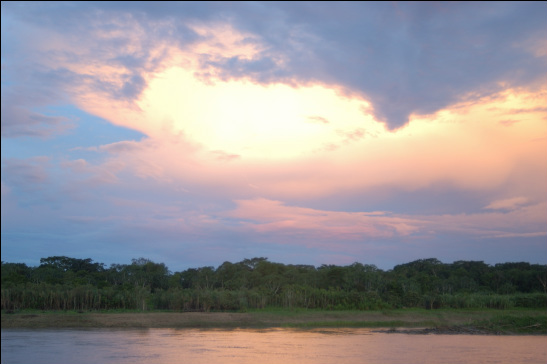
Life is everywhere in the upper Amazon wilderness. Life that creeps, life that crawls, life that slithers, sprouts, burrows, scurries and slinks -- and dies. The dank odors of alternating rot and genesis rise from the mulching forest floor. My Deet-fortified insect spray battles swarms of blood-mad mosquitoes to a draw. The air is fat with syrupy humidity, and I am sweating like an icicle in the sun.
Nature is on fast-forward here. Trees -- palms, laurels, kapoks, mahoganies, bamboos, acacias, figs, balsas, cedars -- jostle each other in the search for a share of the sunlight; they grow to enormous heights and spread their foliage like a green umbrella at the top. Lianas, tropical climbing plants, wind themselves like boa constrictors around the tree trunks and arch themselves in great loops as they, too, struggle upward for a glimpse of light. The trees become parasites, and giant orchids seed themselves in branches 60 feet from the ground. The general effect is of an impenetrable fecund, living wall.
Amid this vast assortment of life, creatures use stunts and flim-flam to befuddle or repel predators, lure prey, seduce mates and gobble food. Caterpillars masquerade as snakes, plants imitate the smell of rotting meat to attract flies as pollinators, and trees rely on fish to distribute their seeds when the rivers flood.
It's a jungle out here.
Not all cruises are on ocean-going palaces where hundreds of passengers flop in deck chairs between all-you-can-gorge buffets and shore excursions to trendy shopping venues. There are alternatives -- such as the so-called niche cruises,which use smaller ships that go to remote destinations inaccessible to the bigger vessels. Fewer guests -- far fewer -- afford a more intimate travel experience that emphasizes history, culture and respect for the environment. Niche cruises go to the Arctic, remote Pacific Islands, the rivers of WestAfrica, Alaska's Inside Passage . . .
And the Peruvian Amazon, where I was one of 24 passengers aboard La Amatista, a 127-foot replica of the river boats owned by 19th Century Amazon rubber barons. In a one-week program developed by International Expeditions, we visited rain-forest villages, fished for piranha and watched a shaman display his arsenal of herbal cures. We sailed 300 miles on the Amazon and its tributaries; along the way we spotted exotic birds and animals -- but no other tourists.
Until a place is visited, it is nothing more than a green smudge on a map or an answer to a test question. My perception of the Amazon had been largely colored by old documentaries and fanciful tales of lost cities, 60-foot snakes, and Indians with blowguns and poisoned darts. I was in for a surprise.
It began with a warning from Robinson Rodriguez, one of two International Expeditions naturalist-guides who accompanied us. "The Amazon is not a zoo. We do not know what we will see today. Every day is different out here, and we wil lsee what we see. We never know." The Amazon experience is quite different from an African safari, where big game is easily spotted. Amazon animals are well camouflaged. Indeed, Rodriguez says that in 17 years as a nature guide he hasnever seen a jaguar.
The next morning, our group boarded two 40-foot, steel-hulled skiffs and zoomed off toward the shore. It is dawn, nature's rush hour. Everywhere there is the chirp and warble of birds. Birds flapping, hovering, hopping, fretting, strutting around like little Napoleons, leaving alphabets of footprints in the muddy banks. Water birds, scavengers, birds of prey, cuckoos, kingfishers,woodpeckers, fly catchers and downright weird birds like the hoatzin, an evolutionary throwback with fright-wig crests and claws on its wings. No one knows for sure how many birds are in the Amazon, but there are well over a thousand species.
Among our first non-ornithological sightings was the world's slowest mammal, the sloth. It stared at us with beady eyes set in a flat face and a round head, anchored with long curved claws upside-down in a tree.
We would see dozens of other creatures throughout the week -- otters, turtles, monkeys, crocodilian creatures called caimans and the fabled pink dolphins of the Amazon. But after the first day, it became apparent to me that there was much more to experience here than animals and birds -- and that the most interesting species was Homo sapiens.
Riberenos -- "people of the bank" -- make up 85 percent of the Peruvian jungle population. They are mestizos, mixed Spanish and Indian, whose ancestors came to work on the rubber plantations in the 1880s. You'll never see a ribereno in a tourist brochure for the Amazon rain forest. They don't wear colorful costumes,they're not headhunters, they don't wear strange lip ornaments -- and if they're not overly friendly it's only because they're busy making a living. Mostly, they raise chickens and fruits to sell in local markets -- and it's not easy.
"Two years ago, the bank was over there," said the mayor of the village of VistaAlegre with a wrinkled wedge of worry between his eyes. He pointed to a spot in the middle of the Pacaya River. "Within a year our school and our church will be gone, and we will have to move." Bank erosion is a perpetual problem in the Amazon.
For a moment, I commiserate with the mayor, but then I ask him why he and his people don't move to higher, more stable ground. He looks at me as though I've just asked the World's Dumbest Question. "Because in the Amazon we have land, we can grow food and fish and feed ourselves. And it's beautiful here. We have birds and monkeys and rivers."
Rivers are the roads of the Amazon jungle, and there was a heterogenous and resurgent stream of vessels passing by La Amatista all week long. Ferries with people who strung their own hammocks on the deck. Dugout canoes, their gunnels a half-inch above the water, carrying families -- fathers paddling, mothers bailing. Rafts made with large trunks united to each other laden with people and plantains. A skiff, its bow mustached in green algae, transporting a soccer team in striped jerseys for a game in the next village. Barges loaded with pickup trucks and three-wheeled motorized rickshaws. Tankers with crude oil headed for refineries.
The banks were lined with villages made up of neat thatched-roof houses on stilts. Every one had a school and a soccer field. Men fished, women washed clothes, children swam, pigs wallowed. At the village of Nuevo Curahuaytillo(population about 50), we watched barefoot boys dribbling soccer balls around a makeshift field with goals fashioned from logs. Copper-brown women walked erect under water pots. The community consisted of a small huddle of dwellings surrounded by exuberant tropical foliage. In the distance were harvested rice paddies bristling with stubble.
The school was an open wooden building whose faded color was more a memory of blue than actual blue. A teacher named Carmen invited us to join a classroom of 19 primary pupils, who shyly smuggled giggles to each other. They introduced themselves and sang songs, including the Peruvian national anthem.
We have come bearing school supplies -- pens, pencils, tablets, notebooks,rulers -- that we give to the teacher for distribution to the students. At every village we visit, we are cautioned beforehand not to give the children money." Our Amazon children are not beggars," says Rodriguez, "and we don't want them to become beggars."
In the village of Curandero, we are introduced to Tito Armas Panaito, a shaman, or rain-forest healer, who is wearing cargo pants, a striped T-shirt and Reebok running shoes. "My mother left me the gift when she died," he tells me, with Rodriguez as a translator. "I was 10 years old. After many years of study, I began practicing."
Panaito passes us his botanical remedies -- lemon juice for insomnia, wild basil for saladenas ("bad luck"), mistletoe for healing broken bones after they are set, wild garlic for gallstones. Though he doesn't show it to us, he is also carrying ayahuasca, the centuries-old concoction of Amazon plants that has hallucinogenic properties and is therefore illegal in the United States.
Like most Amazon shamans, Panaito has no successor in sight. "Each time one of our shamans dies without passing his arts on to the next generation," Rodriguez says, "the world loses thousands of years of irreplaceable knowledge about medicinal plants. It's as if a library has burned down."
The next evening, in gray, creeping twilight, we boarded the skiffs and headed up the Pacaya River. The boat sliced through meadows of surface plants -- a floating green carpet that kept clogging the motor's propeller. The bats had left their daytime hiding places, and a flashlight revealed their rust-redbellies and long narrow ears. One of them suddenly dipped into the water, gaffed a fish with its feet and flipped it into its mouth.
The skiff glided smoothly, bow-first, into the bank. We stepped off and walked down a jungle path. We wore leather gaiters on our shins as protection against poisonous snakes. The night thickened and we inched our way with flashlight beams. The air was rank with putrefaction and decay. We stopped in a clearing, and Rodriguez instructed us to turn off all lights and listen. In the sightless, inky void, our ears focused on the night-hum of the forest. The relentless sibilation of insects. Cicadas grinding their scissors. The bic-bic-bic of frogs. The excited jabber of monkeys. An owl filling the night with questions.
On the return trip to La Amatista, the dark sky veined and forked with lightning, and then unzipped a rain of biblical proportions. We went to our cabins drenched but happy.
This is not the cruise for anyone looking for luxury and relaxation, but the facilities were more than adequate for comfort. The cabin crew was extremely attentive. Our used clothing was laundered every day, and our muddy boots were dried and cleaned after every outing. The rooms were pleasant and air-conditioned. There were three meals a day, simple fare served buffet-style.
The honor-system cash bar was open 24 hours. Dinner each night was preceded by a happy hour with music from a band composed of the two guides, the bartender and two cabin staff.
And, of course, we were in the middle of the largest, most biologically diverse wilderness on Earth.
"Proud People of Mongolia"
A proud people embrace democracy and shape a new future for themselves
© Copyright William Ecenbarger
Reader's Digest
I am in the Hangayn Mountains of central Mongolia, and there is no sign of any century except the 13th.
The steady rumble of thousands of hooves is broken only by the shouts of the herdsmen and the crack of their whips. A dozen nomadic families on horseback, with all their possessions loaded on camels, are herding their sheep and goats north across the frozen landscape, following the seasonal ebb and flow of grazing vegetation. Their ancestors have done this for hundreds of years.
This is the Mongolia of my imagination, a place so distant that it is a metaphor for remoteness, sparsely populated by descendants of bloodthirsty barbarians who rampaged across Asia centuries ago. It's a nation long isolated by its harsh landscape and, in more recent times, held in the grip of the Soviet Union.
I have come at a pivotal time in this nation’s history. Although democracy is still a concept in one neighbour (China) and faltering in another (Russia), Mongolians in 2005 voted in their ninth open, contested election since 1990. Like many Mongolians, my guide Battogtokh, a 52-year-old environmental scientist who has just returned from three years of study in the US, is an ardent supporter of democracy. “Even though many people were better off economically under the Soviets, Mongolians do not want to return to those days, he tells me.
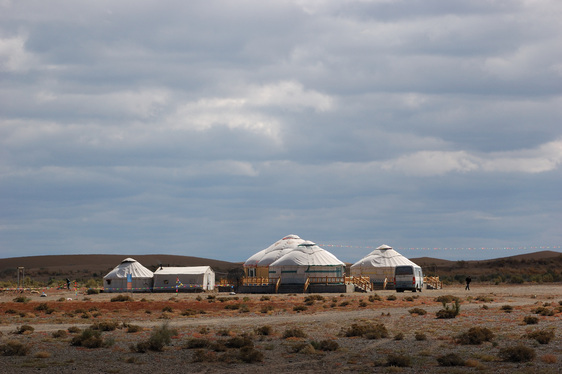
The transition can be startling: in the capital city, Ulaanbaatar, ride-sharing can mean two on a horse, and a home in the suburbs is a ger -- a teepee that is the traditional home of nomads. But the fruits of free enterprise are everywhere. At the City Nomad Restaurant in the heart of downtown Ulaanbaatar, there’s a photo of the street outside taken in 1979 that shows not a car in sight. Today the site is boiling with traffic and people. At the State Department Store, shoppers stroll past displays of computers, designer jeans, kitchen gadgets, caviar, champagne and travel guides to Europe and North America.
But how has the rest of the country changed? Is the new spirit of democracy thriving there? And what of the Mongolia of my imagination -- the land of steppes, desert and mountains? To find out, I embarked on a 3000km, 12-day journey with Battogtokh as my guide. Our driver is Otko, a former taxi driver who has built a one-man business carrying people around Mongolia in his prized UAZ 469, a rugged jeep originally built for the Russian Army.
Even in mid-June, the air in the Hangayns has some winter in it, and suddenly nature bares its teeth. It begins as gentle rain. Soon snowflakes are descending, then hail batters our jeep’s metal roof. We stop near the top of a mountain and step out. I feel a cold wind cut into me. A thunderstorm rolls in, and fangs of lightning bite at the leaden sky.
We slip and slide down the other side of the mountain before pulling up to a solitary ger. Unannounced, we step through the doorway and are greeted warmly by a man who gives each of us a Mongolian handshake -- a grabbing of the elbows.
His name is Tserenkhuu. In the ger we warm our hands by the wood stove as he introduces us to his wife and three daughters. Immediately, we are served tea and hard biscuits. While we munch and talk with Tserenkhuu, his wife takes down a huge slab of raw mutton hanging on the wall and begins chopping it. Soon there’s the aroma of boiled lamb. After dinner, a communal bowl of vodka is passed, and an hour later we are asleep on the carpeted floor. Four other visitors join us in the middle of the night.
In the morning, our hosts give everyone breakfast, and we leave, wished well by their smiles. Hospitality, I quickly learn, is woven deeply into the life of these nomads dwelling in the world’s most sparsely settled country (just 1.4 people per square kilometre) and in one of the world’s harshest climates (long winters with temperatures dropping to -30C, and brief, scorching summers of 40C or more).
Before 1990, Galaa was a herdsman for a government co-operative, which paid him $8 a month to manage 600 animals. “I felt very pressured, but I had children. There was no choice. Today I can do whatever I want, and what I want to do is open a restaurant.”
He refuses to allow me to photograph him at the construction site. “It would be bad luck,” he explains. With that, he dips the third finger of his right hand into a bowl of vodka three times, flicking liquid to the air, then towards the hearth, then the ground. This is the traditional offering to the spirits of sky, fire and earth.
Such ancient traditions are everywhere in Mongolia. The most tangible manifestation are the ovoos -- cairns at crossroads and other important points. These spontaneous shrines began as a shamanistic practice, but the idea was later adopted by Buddhist monks.
They seem to grow organically, like coral, because passers-by are constantly adding to them -- scraps of cloth, empty bottles, animal bones, small amounts of money. Some are as high as 15 metres. Most Mongolians believe that adding to an ovoo is a step closer to nirvana; disrespect towards one will lead to death. Although stealing is fairly common, seldom does anyone take cash from an ovoo.
About a week into our journey, we are at the site of the ancient city of Karakorum, centre of the Mongol empire. It was a city so cosmopolitan that both Mongolian and foreign currencies were accepted as legal tender, and so tolerant that 12 religions coexisted within its walls. From here the Mongols forged one of the largest land empires in history, stretching from southern China to the Danube River.
Genghis Khan’s name may epitomise barbarity in much of the world, but modern Mongolians associate him with democratic principles. They are backed by a growing body of scholarship. “The Mongolian people today, having learnt his story from their grandparents, know that he codified the four basic principles that make a country a democracy: participatory government, rule by law, equality under the law and personal freedoms,” says Dr Paula Sabloff of the University of Pennsylvania Museum of Archaeology and Anthropology.
“What is even more surprising is that Genghis Khan established these democratic principles nine years before King John signed the Magna Carta in 1215, the document that initiated British democracy.”
Back in Ulaanbaatar, I go to the National Museum of Mongolian History, where an entire floor is devoted to Genghis Khan and his legacy. The story of Mongol exploits survived almost 70 years of official Soviet disapproval. No longer is it wrong to point out that the Mongols crushed the Russian army and occupied huge parts of Russia for decades. Indeed, the revival of Genghis Khan is everywhere: his name is on postage stamps, currency, vodka, a hotel and a brewery. He is nothing less than a national icon.
On the morning of my departure, I go to the Zaisan Memorial, erected in 1967 in part to commemorate the 50th anniversary of the Russian Revolution. It affords the best view of the city.
Ulaanbaatar is built along the Tuul River and surrounded by majestic mountains that stand out against the ugly Soviet architecture of high-rise concrete. Ger suburbs encircle the city, and residents are beginning to fence off their land as the concept of private property takes hold. The memorial features a large circular mosaic depicting the friendship between the Mongol and Soviet peoples. It has been defaced by a collage of graffiti. The “eternal flame” has been extinguished for several years. Nearby, an ovoo is rising steadily.
"Good morning, sunshine Lubec, at the far edge of Maine, is where America starts its day"
© Copyright William Ecenbarger
The Star-Ledger
(Newark, New Jersey)
LUBEC, Maine--America's day begins here at a 200-year-old lighthouse that this morning is ringed by a halo of gulls. As the sun chins itself up over the Atlantic horizon, the glare of the dawn's earliest light erases all distance and perspective.There is just the immense blue fabric of the sea, loppy-waved, rumpled andcreased.
The curtain has risen at the easternmost point in the United States; there's not much of a plot and even less suspense, but the special effects are dazzling -all rubies and amber and crystal. The air is heavy with salt and spray, and the wind is blowing foamy feathers off the long curling swells.
I button my jacket and pull up my hood.
This is the far edge of Maine, 240 miles east-northeast of Portland. This is a place of wild blueberry patches, volunteer fire departments, grange halls,cottages with window boxes spilling blossoms, yards where lobstermen hang their freshly repainted buoys out to dry, and towns with band shells draped in American flag bunting.
The weekly Lubec Light carries important news of tide times, Eagle scouts, bakesales, church suppers, new library books, births, illnesses and deaths.
"Mister, you're looking at what's left of Maine," I was informed by a man with a craggy face and a squint like a cowboy in an old cigarette ad. "You go 40 miles south of here, you're in Massachusetts. Cross my heart." (Only it came out this way: "Mistah, yaw lookin' at what's lefta Maine. Go fawty miles south of hee-ah, yaw in Mass-chew-sits. Crossma hot.")
Lubec is in the middle of some of the most spectacular scenery in the country -miles of coastline, rugged headlands, towering sea cliffs, pine-studded islands,coves, inlets, lakes, woodland, bogs, whirlpools and waterfalls. As the high pilings in the harbor attest, Lubec has the greatest rise and fall of tides in the continental United States - a 20-foot variance in just six hours.
And just five minutes away, across an international bridge into Canada, there's a huge bonus for history buffs - Campobello, the beloved cottage retreat of Franklin D. Roosevelt, where the future president summered from 1883 until August, 1921, when he came down with polio there.
The red-and-white-striped West Quoddy Lighthouse looks like a barbershop pole.Today it attracts hikers to several well-maintained trails that lace West Quoddy State Park. If you're lucky, you may spot a moose and a whale on the same hike.
This morning the beauty of the scene almost defies nomenclature, and the land seems worthy of national park status. I walk along cliffs that rise 100 feet and more above the surf raging against weathered rocks below to my left; on the right, the light slants through firs and other evergreens. The air is resinous with balsam.
The sounds are all non-human and welcome. The wind makes the trees creak, waves lap gently on granite, gulls screech, buoys clang and whales bark. Multi-colored lobster buoys ride the swells in the sea below.
After a mile, the trail turns away from the coast and into the forest. Suddenly everything - ground, rocks, trees - is covered with moss. It seems to have snowed moss. Light filters through the canopy of trees, giving an infinite variety of greens. It is surreal, hallucinatory - like the illustrations of old fairy tale books.
Later, a few miles away in Lubec harbor, I watch fishermen wearing wife-knitted sweaters and carrying lunchboxes row out to moored boats that sit patiently o ntheir reflections. Their diesel engines gurgle to life, and before long they are in full-throttle roar with their wakes boiling behind. Since Lubec was settled in 1785, its backbone has been its fishing fleet.
Lubec is a fishing village, 50 miles from the nearest traffic light, whose frame houses face the sea. Some of them are 150 years old. I have fish chowder for lunch at Cohill's Inn and Pub as a colony of gray harbor seals basks on the granite rocks of the breakwater. Jack, the bartender, tells me that he's a U.S.and a Canadian citizen. I sit back and knit my fingers as if to say, "I'm listening."
"You can't do that anymore if you were born after '47," he says, downshifting a Guinness and sliding it in a single motion to a patron who has just entered without speaking. "But we all get along just fine. Some people cross the bridge five, six times a day."
Since 1962 Lubec has been connected by bridge to the Canadian island of Campobello, and a kind of transpontine dependency evolved. There are no gas stations on Campobello, no pharmacies in Lubec. There are family ties, friendships and business relationships that run deeper than national allegiance.
Volunteer firemen from both sides often respond to a single blaze.
It is not surprising that the world's first international park was established in 1962 at the southern end of Campobello Island, where the young Franklin Roosevelt learned to swim and sail, where he wooed Eleanor as his future bride, spent summers with his children and first decided to run for public office in 1910.
Centerpiece of the 2,800-acre Roosevelt Campobello Park is the family "cottage,"which in fact is a three-story, vermillion-colored, 34-room gambrel mansion built in the Arts and Crafts style and overlooking Passamaquoddy Bay.
The house contains an astonishing number of Roosevelt memorabilia - the woodstove that cooked family meals, Eleanor's knitting basket, a room with old-fashioned school desks where the children sat for their daily lessons, and two giant megaphones the Roosevelts used to hail passing ships and to summon the family to dinner.
On the wall in the entrance room is a Christmas note that 7-year-old Franklin wrote for his mother in 1889.
Not only is Campobello a class operation - it's free. Allow at least a half-day to tour the cottage and its handsome gardens. Start at the visitor's center, which has a brief video outlining the history of the island and the Roosevelts'influence.
But there's more to see. There are bogs, beaches, shoreline trails and hiking paths purchased by the park to protect the area from development. Campobello Island, which is only 10 miles long and three miles wide, has uncrowded beaches and craggy vantage points with stunning views of the sea.
There's no easy way to get to this area. It's a good two-hour drive beyond Acadia National Park. But those who make the effort will be amply rewarded.
(Newark, New Jersey)
LUBEC, Maine--America's day begins here at a 200-year-old lighthouse that this morning is ringed by a halo of gulls. As the sun chins itself up over the Atlantic horizon, the glare of the dawn's earliest light erases all distance and perspective.There is just the immense blue fabric of the sea, loppy-waved, rumpled andcreased.
The curtain has risen at the easternmost point in the United States; there's not much of a plot and even less suspense, but the special effects are dazzling -all rubies and amber and crystal. The air is heavy with salt and spray, and the wind is blowing foamy feathers off the long curling swells.
I button my jacket and pull up my hood.
This is the far edge of Maine, 240 miles east-northeast of Portland. This is a place of wild blueberry patches, volunteer fire departments, grange halls,cottages with window boxes spilling blossoms, yards where lobstermen hang their freshly repainted buoys out to dry, and towns with band shells draped in American flag bunting.
The weekly Lubec Light carries important news of tide times, Eagle scouts, bakesales, church suppers, new library books, births, illnesses and deaths.
"Mister, you're looking at what's left of Maine," I was informed by a man with a craggy face and a squint like a cowboy in an old cigarette ad. "You go 40 miles south of here, you're in Massachusetts. Cross my heart." (Only it came out this way: "Mistah, yaw lookin' at what's lefta Maine. Go fawty miles south of hee-ah, yaw in Mass-chew-sits. Crossma hot.")
Lubec is in the middle of some of the most spectacular scenery in the country -miles of coastline, rugged headlands, towering sea cliffs, pine-studded islands,coves, inlets, lakes, woodland, bogs, whirlpools and waterfalls. As the high pilings in the harbor attest, Lubec has the greatest rise and fall of tides in the continental United States - a 20-foot variance in just six hours.
And just five minutes away, across an international bridge into Canada, there's a huge bonus for history buffs - Campobello, the beloved cottage retreat of Franklin D. Roosevelt, where the future president summered from 1883 until August, 1921, when he came down with polio there.
The red-and-white-striped West Quoddy Lighthouse looks like a barbershop pole.Today it attracts hikers to several well-maintained trails that lace West Quoddy State Park. If you're lucky, you may spot a moose and a whale on the same hike.
This morning the beauty of the scene almost defies nomenclature, and the land seems worthy of national park status. I walk along cliffs that rise 100 feet and more above the surf raging against weathered rocks below to my left; on the right, the light slants through firs and other evergreens. The air is resinous with balsam.
The sounds are all non-human and welcome. The wind makes the trees creak, waves lap gently on granite, gulls screech, buoys clang and whales bark. Multi-colored lobster buoys ride the swells in the sea below.
After a mile, the trail turns away from the coast and into the forest. Suddenly everything - ground, rocks, trees - is covered with moss. It seems to have snowed moss. Light filters through the canopy of trees, giving an infinite variety of greens. It is surreal, hallucinatory - like the illustrations of old fairy tale books.
Later, a few miles away in Lubec harbor, I watch fishermen wearing wife-knitted sweaters and carrying lunchboxes row out to moored boats that sit patiently o ntheir reflections. Their diesel engines gurgle to life, and before long they are in full-throttle roar with their wakes boiling behind. Since Lubec was settled in 1785, its backbone has been its fishing fleet.
Lubec is a fishing village, 50 miles from the nearest traffic light, whose frame houses face the sea. Some of them are 150 years old. I have fish chowder for lunch at Cohill's Inn and Pub as a colony of gray harbor seals basks on the granite rocks of the breakwater. Jack, the bartender, tells me that he's a U.S.and a Canadian citizen. I sit back and knit my fingers as if to say, "I'm listening."
"You can't do that anymore if you were born after '47," he says, downshifting a Guinness and sliding it in a single motion to a patron who has just entered without speaking. "But we all get along just fine. Some people cross the bridge five, six times a day."
Since 1962 Lubec has been connected by bridge to the Canadian island of Campobello, and a kind of transpontine dependency evolved. There are no gas stations on Campobello, no pharmacies in Lubec. There are family ties, friendships and business relationships that run deeper than national allegiance.
Volunteer firemen from both sides often respond to a single blaze.
It is not surprising that the world's first international park was established in 1962 at the southern end of Campobello Island, where the young Franklin Roosevelt learned to swim and sail, where he wooed Eleanor as his future bride, spent summers with his children and first decided to run for public office in 1910.
Centerpiece of the 2,800-acre Roosevelt Campobello Park is the family "cottage,"which in fact is a three-story, vermillion-colored, 34-room gambrel mansion built in the Arts and Crafts style and overlooking Passamaquoddy Bay.
The house contains an astonishing number of Roosevelt memorabilia - the woodstove that cooked family meals, Eleanor's knitting basket, a room with old-fashioned school desks where the children sat for their daily lessons, and two giant megaphones the Roosevelts used to hail passing ships and to summon the family to dinner.
On the wall in the entrance room is a Christmas note that 7-year-old Franklin wrote for his mother in 1889.
Not only is Campobello a class operation - it's free. Allow at least a half-day to tour the cottage and its handsome gardens. Start at the visitor's center, which has a brief video outlining the history of the island and the Roosevelts'influence.
But there's more to see. There are bogs, beaches, shoreline trails and hiking paths purchased by the park to protect the area from development. Campobello Island, which is only 10 miles long and three miles wide, has uncrowded beaches and craggy vantage points with stunning views of the sea.
There's no easy way to get to this area. It's a good two-hour drive beyond Acadia National Park. But those who make the effort will be amply rewarded.
"The Full Bronte"
© Copyright William Ecenbarger
Smithsonian Magazine.com
(The British countryside is home to the real sites behind Jane Eyre, Wuthering Heights and other works by the literary sisters)
The storm had been assembling itself all morning, and finally the glowering sky, veined with lightning, loosed a rain of Old Testament proportions. Alan Pinkney looked up approvingly, then turned to the seven walkers he was leading and exclaimed, “This is perfect,” I can almost see Heathcliff riding across the moor!”
We had ignored the clouds to hike some three miles to a remote, ruined farmhouse named Top Withins. It was little more than crumbling walls, but in its original form it is widely believed to have been the model for Wuthering Heights, home of the wild and mysterious Mr. Heathcliff in Emily Bronte’s classic 1847 novel of passion, rage and revenge.
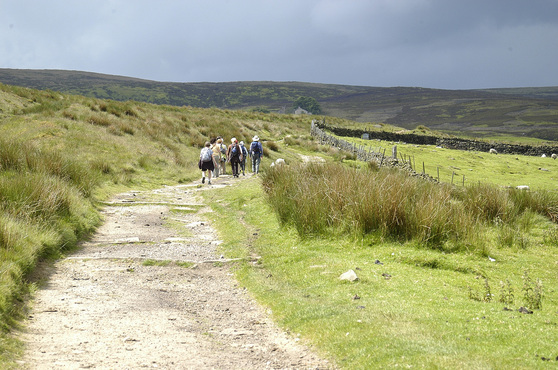
This was the first of five days that we followed in the footsteps of Britain’s most famous literary family, the Bronte sisters ”Emily, Charlotte and Anne,” the authors of Wuthering Heights, Jane Eyre and other, lesser-known masterpieces. Like the sisters a century and a half earlier, we took long walks across the bleak Yorkshire moors and through the stupendous sweep of scenery in Derbyshire’s Peak District, all the while touching the landscapes and buildings that animated their work.
“A Bronte tour is unparalleled in its richness because you have the unique situation of three literary geniuses spending most of their creative lives in the same place,” says Pinkney, who spent three weeks putting together the walk along the “Bronte Trail” for the Wayfarers, a 25-year-old British company specializing in small-group walking tours. “And the only way to do it right is on foot.”
Indeed, it can be argued that much of 18th- and 19th-century English literature was born afoot. Not only the Brontes, but Charles Dickens, Thomas Hardy, Samuel Coleridge, William Wordsworth, John Keats, Sir Walter Scott, Jane Austen and Thomas Carlyle were all members in good standing of the walkers club. (In fact, previous Wayfarers walks have focused on Hardy, Wordsworth and Scott, and there are plans for an Austen walk.)
Ground zero for a Bronte pilgrimage is Haworth, a former wool-manufacturing town whose cobblestone streets climb steeply to a square and St. Michael’s Parish church, where the sisters’ father, Patrick Bronte, was curate and where the family vault lies beneath an inscribed stone. The church has been rebuilt since the Brontes’ day, but a few steps away is the parsonage, a stone Georgian structure that remains much as it was when it was built in 1778. The sisters spent nearly all of their lives there, and it is now operated as a museum by the Bronte Society.
The museum is furnished with an array of Bronte artifacts, including Charlotte's wedding bonnet, Anne's writing desk and the black sofa where Emily died. Just to the left of the entrance door is the dining room, where the sisters penned their novels by candlelight. “With the amount of creativity going on here back then, it’s a miracle the roof didn’t blow off,” says Ann Dinsdale, museum collections manager, who gave several talks to our group.
Leaving the parsonage, we walked single file past the graveyard and its tombstones canted by the frosts of hundreds of Yorkshire winters. The inscriptions identify dozens of children and young adults. Haworth was a grim place during the Brontes’ time, as disease reduced life expectancy to 25 years. (All three sisters died in their 30s, Emily and Anne of tuberculosis in 1848 and 1849, respectively, and Charlotte of tuberculosis and complications from pregnancy in 1855.)
Soon we were on the moors. While the parsonage was the Brontes’ creative sanctuary, it was the wild and desolate moors that fired their imaginative and descriptive powers. Early in Wuthering Heights, Emily wrote: “[O]ne may guess the power of the north wind...by the excessive slant of a few stunted firs... and by a range of gaunt thorns all stretching their limbs one way, as if craving alms from the sun.”
We were on our way to a tiny waterfall that was a favorite destination of the sisters. We walked along the same ancient right of way, past green hillsides speckled with white sheep and demarcated by stone walls thick with history. After the falls, it was another mile to Top Withins, where the lightning unzipped the sky and the rain came down in sheets.
Then we were on England’s famous Pennine Way, a 267-mile national trail that runs from Derbyshire north to the Scottish border. As we approached the village of Stanbury, the sun came out, the countryside glistened and a rainbow smiled over the scene. Each day we walked eight to ten miles, pausing to chat with the characters of the English countryside and inhaling the lusty odors of earth amid sounds bovine, equine, porcine and ovine.
Just outside Stanbury we paused at Ponden Hall, a privately owned 17th-century farmhouse that Emily is said to have portrayed as “Thrushcross Grange,” home of the Linton family in Wuthering Heights. At the end of the second day, we sat inside the huge fireplace at Wycoller Hall, which in Charlotte’s Jane Eyre became “Ferndean Manor,” where Jane and Rochester lived at the novel’s end.
By midweek we had shifted from Yorkshire to Derbyshire and the village of Hathersage, which Charlotte portrayed in Jane Eyre as “Morton,” a hamlet set “amongst romantic hills.” The vicarage where she stayed has not changed substantially in 164 years; we heard the same church bells she used in her novel to signal major changes in Jane’s life.
The Peak District landscape seems much as Charlotte’s heroine describes it”“the hills, sweet with scent of heath and rush... soft turf, mossy fine and emerald green.” After four miles we came to North Lees Estate, a castle-like building once owned by the real-life Eyre family and now the property of the national park authority. North Lees emerged as “Thornfield Hall,” home of Jane Eyre’s enigmatic Mr. Rochester.
Pinkney called us to a halt, reverentially opened a dog-eared copy of the novel and began reading: “I looked up and surveyed the front of the mansion. It was three storeys high, of proportions not vast, though considerable: a gentleman's manor-house, not a nobleman's seat: battlements round the top gave it a picturesque look.”The battlements were the stage for one of the most dramatic scenes in English literature”the insane Mrs. Rochester leaping to her death from the fire she had started. Not even the arrival of a red van carrying a utility employee to read the estate’s electric meter could break the mood.
We left the green fields and woodlands of the Hope Valley and made a lung-bursting ascent of some 1,500 feet to the crest of Stanage Edge, a rim of fissured gray rock. As we crossed a 2,000-year-old Roman road, we had to hold on to boulders to avoid being blown down by the gale.
At Moorseats Hall”our final stop on our final day”a fenced-in bull shot us an out-for-blood glare. Charlotte made this “Moor House,” where the starving and penniless Jane was taken in by the Rev. St. John Rivers. Pinkney stood in front of a stone wall and read again: “I put out my hand to feel the dark mass before me: I discriminated the rough stones of a low wall”above it, something like palisades, and within, a high and prickly hedge. I groped on.” We were rapt with attention as he continued reading”“Again a whitish object gleamed before me; it was a gate””and reached out to touch the wall, bringing the moment back through the decades and generations and reminding us why we had taken to calling our trek “the full Bronte.”